Forex Trading in Iran: The Complete Guide for Iranian Traders (2026)
In this article
Forex trading in Iran has grown from a niche activity into one of the most widely practiced forms of financial market participation in the country — with hundreds of thousands of active Iranian traders operating across currency pairs, gold, cryptocurrency, and international stocks in 2026. This guide covers everything an Iranian trader needs to know: from the legal landscape and choosing a broker to strategies, instruments, and the practical mechanics of depositing and withdrawing via USDT.
What Is Forex Trading and Why Is It Popular in Iran?
The foreign exchange market — known universally as forex — is the largest financial market on earth, processing over $7.5 trillion in daily transactions. Unlike stock exchanges, forex has no central location: it operates as a decentralized global network of banks, institutions, and retail traders 24 hours a day, five days a week.
For Iranian traders, forex represents something beyond financial opportunity — it is one of the few accessible pathways to earning hard currency income without leaving Iran. The collapse of the Iranian rial against major currencies over the past decade has made dollar-denominated income a priority for millions of Iranians. Forex, gold, cryptocurrency CFDs, and international stock CFDs all provide this — through international brokers that accept Iranian clients and process deposits via USDT.
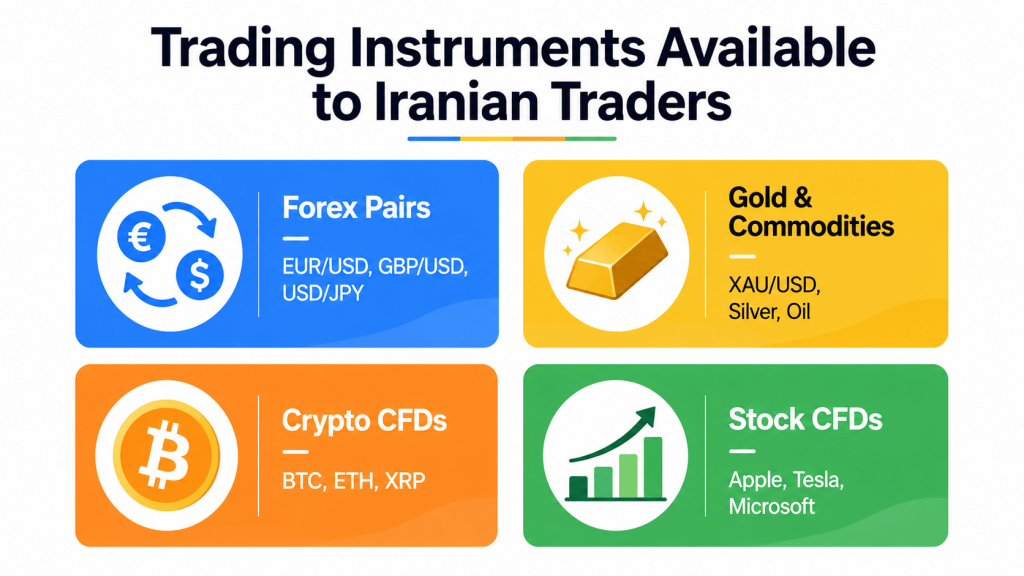
The instruments available to Iranian traders through international brokers fall into four categories:
- Currency pairs (Forex): EUR/USD, GBP/USD, USD/JPY, USD/CHF and dozens more
- Commodities: Gold (XAU/USD), Silver (XAG/USD), Oil (WTI/Brent)
- Cryptocurrency CFDs: BTC/USD, ETH/USD, XRP/USD — without owning the coins
- Stock CFDs: Apple, Tesla, Microsoft, Saudi Aramco — without a US brokerage account
Forex Trading in Iran: Legal Status in 2026
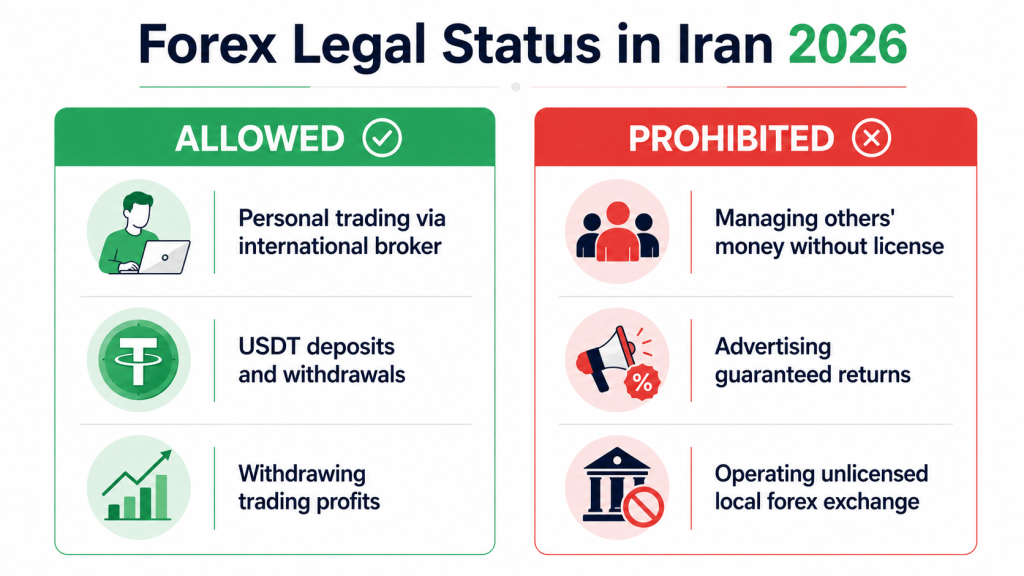
The legal status of forex trading in Iran is one of the most frequently misunderstood topics in the Iranian trading community. The reality is more nuanced than either “completely legal” or “completely banned.”
Iran’s financial regulatory framework, overseen by the Central Bank of Iran (CBI) and the Securities and Exchange Organization (SEO), does not specifically criminalize retail forex trading by individual citizens through international brokers. There is no law that names “forex trading” as a prohibited activity for personal investment purposes.
What the law does regulate:
- Operating as an unlicensed financial service provider — illegal
- Managing third-party funds without authorization — illegal
- Advertising guaranteed returns — illegal and classified as fraud
- Operating a local forex exchange without a license — illegal
What is not prohibited:
- Personal forex trading through an international broker for one’s own account
- Depositing personal funds via USDT to an international trading account
- Withdrawing profits earned from personal trading
In practice, thousands of Iranian traders operate openly — discussing their trades on Telegram channels, YouTube, and Iranian financial forums — without legal consequence. The practical risk for an Iranian retail trader is financial, not legal: choosing an unreliable broker that freezes accounts or blocks withdrawals.
Currency Trading for Iranians: How Forex Pairs Work
A currency pair represents the exchange rate between two currencies. When you trade EUR/USD, you are simultaneously buying euros and selling US dollars — or vice versa. The profit or loss comes from the movement of the exchange rate.
Every forex pair has two prices:
- Bid price: the price at which the broker buys from you (you sell here)
- Ask price: the price at which the broker sells to you (you buy here)
- Spread: the difference between the two — this is the broker’s fee on each trade
The most actively traded pairs among Iranian traders:
| Pair | Nickname | Why Popular in Iran | Typical Spread (ECN) | Best Trading Hours (Tehran) |
|---|---|---|---|---|
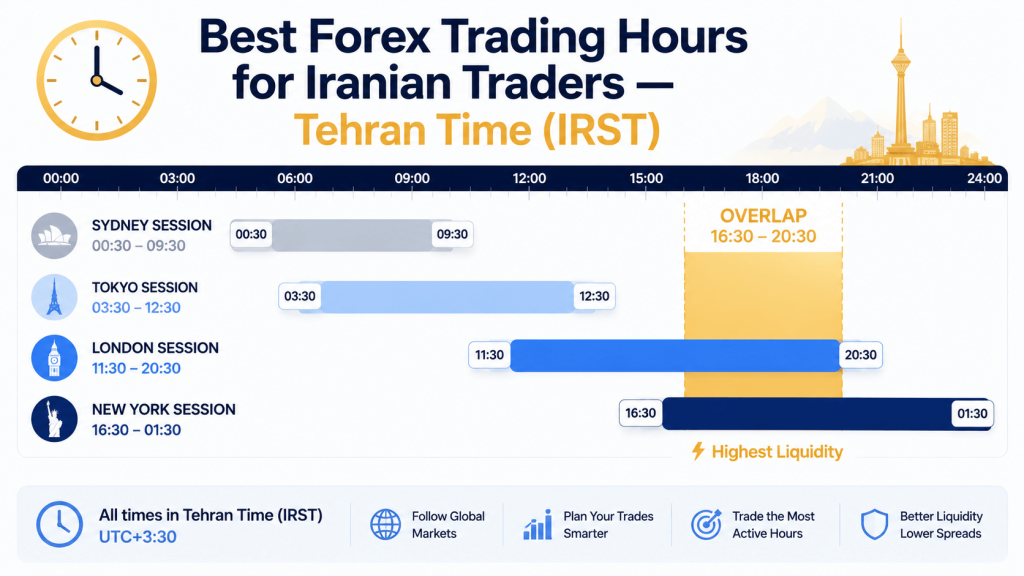
| EUR/USD | The Euro | Highest liquidity, lowest spread, most predictable | 0.1–0.3 pip | 11:30 – 20:30 |
| GBP/USD | Cable | High volatility during London session | 0.2–0.5 pip | 11:30 – 20:30 |
| USD/JPY | The Yen | Active during Tehran evening (NY session) | 0.1–0.3 pip | 16:30 – 01:30 |
| XAU/USD | Gold | Cultural familiarity, dollar hedge, high volatility | $0.20–$0.50 | 11:30 – 20:30 |
| USD/CHF | The Swissy | Safe haven, inverse to EUR/USD | 0.3–0.6 pip | 11:30 – 20:30 |
Gold Trading (XAU/USD) for Iranian Traders
Gold holds a special place in Iranian culture and financial tradition. For centuries, physical gold — coins, jewelry, gold bars — has been the primary store of value for Iranian families. This cultural familiarity makes gold trading (XAU/USD) by far the most popular instrument among Iranian forex traders in 2026.
Trading gold through a forex broker offers significant advantages over owning physical gold:
- No storage cost: no need to physically secure gold
- Leverage: control large positions with a small deposit
- Short selling: profit from falling gold prices, not just rising ones
- 24-hour access: trade gold during any market session
- No premium over spot price: unlike physical gold dealers who charge 5–15% above spot
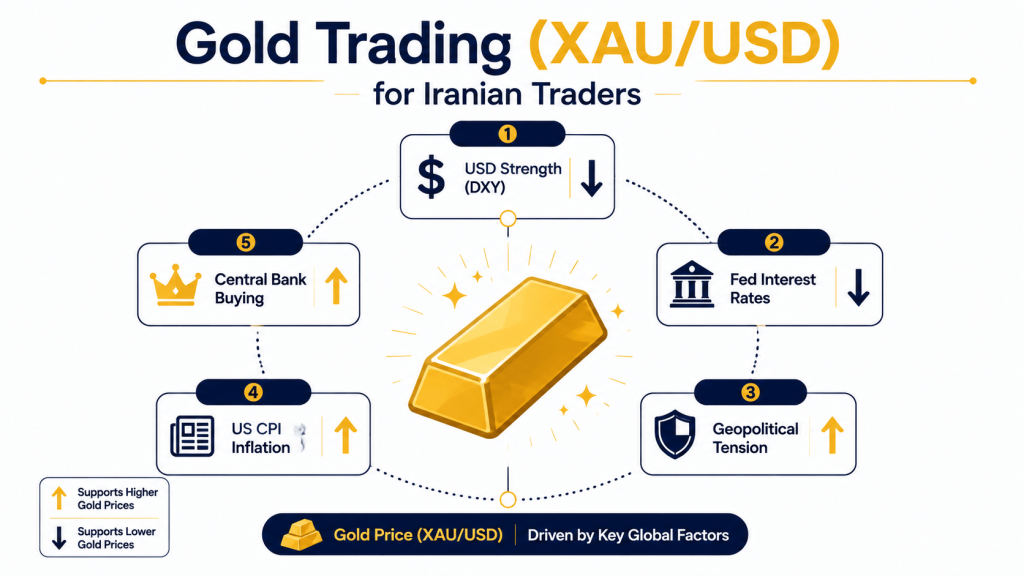
Key factors that move gold prices — what Iranian gold traders must monitor:
| Factor | Effect on Gold | How to Track |
|---|---|---|
| US Dollar strength (DXY) | Strong dollar → gold falls; Weak dollar → gold rises | DXY index on TradingView |
| US Federal Reserve interest rates | Rate hike → gold falls; Rate cut → gold rises | Fed announcements (FOMC) |
| Geopolitical tension | Conflict/uncertainty → gold rises (safe haven) | Reuters, Bloomberg news |
| US CPI inflation data | High inflation → gold rises as hedge | Economic calendar |
| Central bank gold purchases | Large purchases → gold rises | World Gold Council reports |
Cryptocurrency CFD Trading for Iranians
Iranian traders are already among the most active cryptocurrency users in the world — Bitcoin mining has been significant in Iran, and USDT is the de facto dollar substitute for millions of Iranians. This familiarity with crypto makes cryptocurrency CFD trading a natural extension.
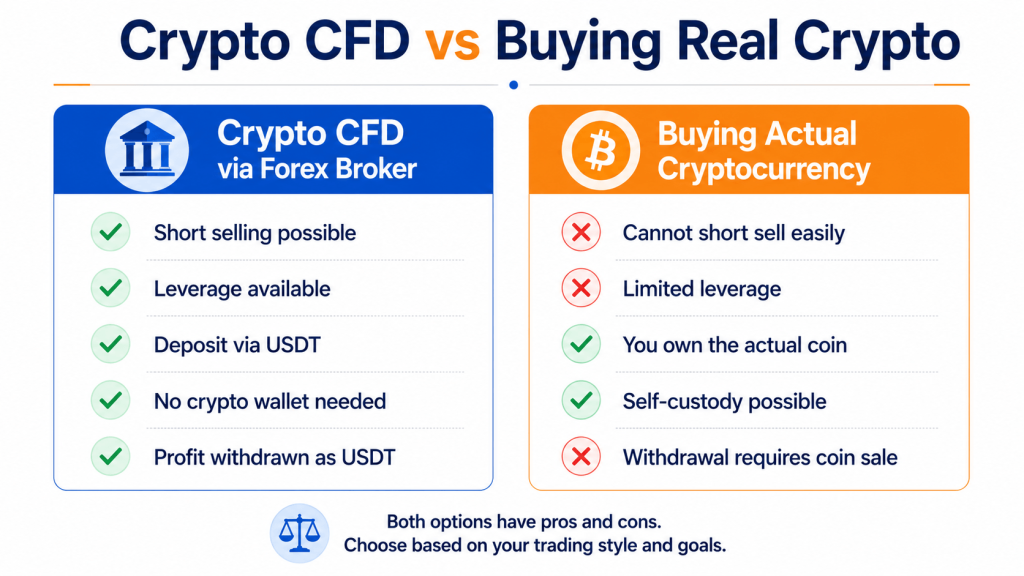
The key distinction: trading crypto CFDs through a forex broker is fundamentally different from buying actual cryptocurrency:
| Crypto CFD (Forex Broker) | Buying Actual Crypto | |
|---|---|---|
| Ownership | You don’t own the coin — only the price exposure | You own the actual coin |
| Short selling | ✅ Yes — profit from price drops | ❌ Complicated (requires exchange margin) |
| Leverage | ✅ Up to 1:10 or more | Limited |
| Deposit method | USDT → broker account | Purchase directly |
| Wallet required | ❌ No crypto wallet needed | ✅ Yes |
| Withdrawal | Profit withdrawn as USDT | Sell coins to USDT |
Most actively traded crypto CFDs among Iranian traders:
- BTC/USD — Bitcoin: highest liquidity, most recognized, best for analysis
- ETH/USD — Ethereum: high volatility, responds strongly to tech news
- XRP/USD — Ripple: often follows BTC with amplified moves
- LTC/USD — Litecoin: lower volatility than ETH, suitable for beginners
Stock CFD Trading for Iranians: Access to Global Markets
One of the most significant advantages of trading through an international forex broker is access to global stock markets — without needing a US brokerage account, without SWIFT transfers, and without the restrictions that make direct stock ownership nearly impossible for Iranian citizens.
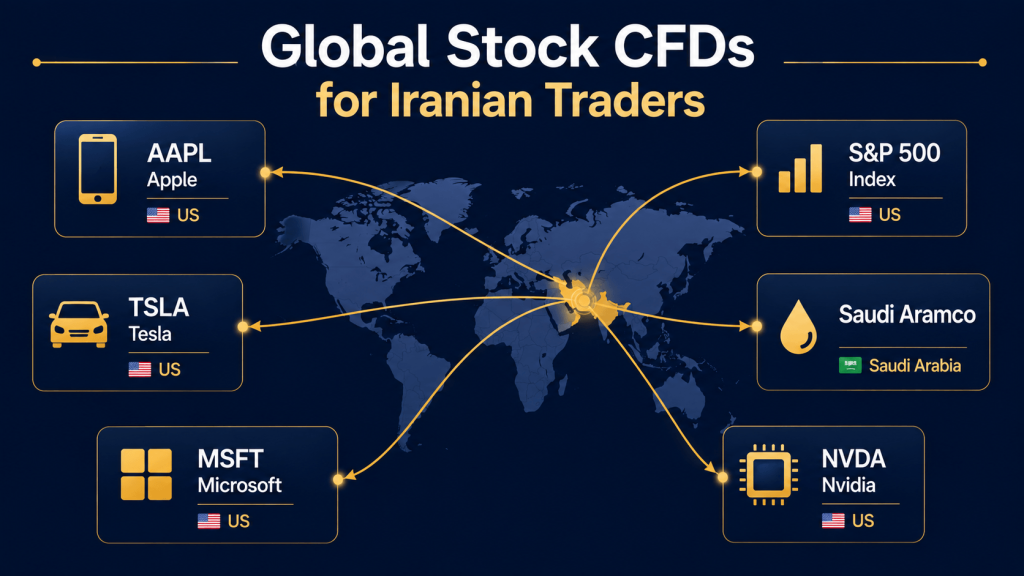
Through stock CFDs (Contracts for Difference), Iranian traders can take positions on:
- US stocks: Apple (AAPL), Tesla (TSLA), Microsoft (MSFT), Amazon (AMZN), Nvidia (NVDA)
- European stocks: LVMH, Volkswagen, Nestlé, Shell
- Asian stocks: Toyota, Samsung, TSMC
- Saudi stocks: Saudi Aramco (TADAWUL listed)
- Stock indices: S&P 500, Nasdaq 100, DAX 40, FTSE 100
Stock CFDs trade during the underlying exchange’s hours — the US stock market (NYSE and Nasdaq) is open from 17:30 to 00:00 Tehran time during standard time, making it accessible during Iranian evening hours.
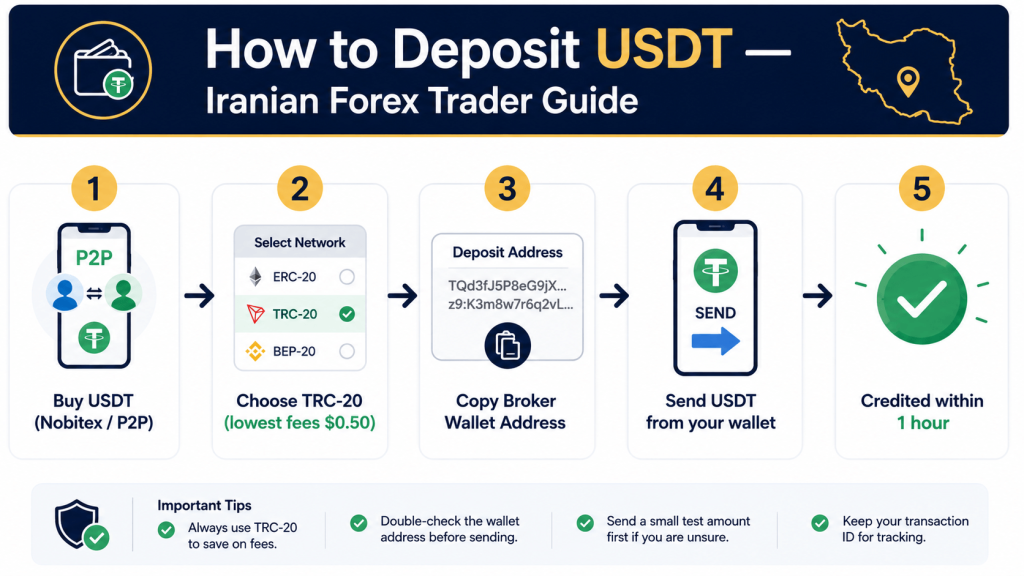
How to Deposit and Withdraw: USDT Guide for Iranian Traders
The banking sanctions environment makes USDT (Tether) the dominant — and in most cases the only practical — deposit and withdrawal method for Iranian forex traders. Understanding the mechanics is essential before opening a live account.
Step 1: Acquire USDT
Purchase USDT from a trusted source. Options available to Iranian traders:
- Nobitex (نوبیتکس): Iran’s largest licensed cryptocurrency exchange
- P2P platforms: Binance P2P, OKX P2P — peer-to-peer with Iranian sellers
- Local OTC desks: physical and Telegram-based USDT dealers
Step 2: Choose the Right Network
USDT operates on multiple blockchain networks. For forex deposits:
| Network | Transaction Fee | Speed | Recommendation |
|---|---|---|---|
| TRC-20 (Tron) | $0.50–$2 | 1–3 minutes | ✅ Best for most deposits |
| ERC-20 (Ethereum) | $5–$30 | 2–10 minutes | ⚠️ Higher fees — use only if TRC-20 unavailable |
| BEP-20 (BSC) | $0.10–$0.50 | 1–3 minutes | ✅ Low fee alternative — check broker support |
Step 3: Deposit to Your Broker Account
- Log in to your broker account (e.g., Investizo via forexirantrading.com)
- Navigate to Deposit → select USDT → select TRC-20 network
- Copy the wallet address provided — do not type it manually
- Send USDT from your wallet to this address
- Wait for blockchain confirmation — typically 5–20 minutes
- Broker credits your account — usually within 1 hour
Step 4: Withdraw Profits
- Withdraw → USDT → TRC-20 → enter your personal wallet address
- Reliable brokers process USDT withdrawals within 1–24 hours
- Withdraw to your own wallet — not directly to an exchange
Forex Trading Strategies for Iranian Traders
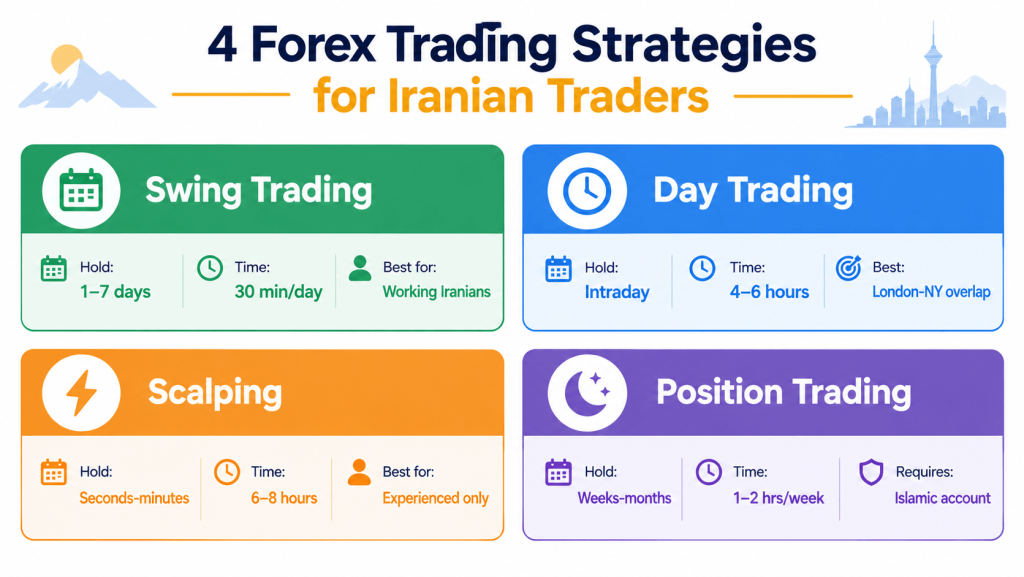
There is no single “best” strategy for forex trading in Iran — the right approach depends on your schedule, personality, risk tolerance, and the time you can dedicate to market analysis. Here are the four main strategic frameworks used by experienced Iranian traders:
1. Swing Trading — Best for Working Iranians
Swing trading involves holding positions for 1 to 7 days, capturing medium-term price movements. This is the most practical strategy for Iranian traders who have a day job and cannot watch the markets constantly.
- Time required: 30–60 minutes per day for analysis
- Best instruments: EUR/USD, GBP/USD, XAU/USD
- Analysis type: Daily and 4-hour charts, support/resistance levels
- Risk per trade: 1–2% of account capital
2. Day Trading — For Active Traders
Day traders open and close all positions within a single trading day, never holding overnight. This eliminates swap fees — relevant for Iranian traders without Islamic accounts.
- Time required: 4–6 hours of active screen time per day
- Best session for Iranians: London-New York overlap (16:30–20:30 Tehran time)
- Best instruments: EUR/USD, XAU/USD, GBP/USD
- Risk per trade: 0.5–1% of account capital
3. Scalping — For Experienced Traders Only
Scalping involves taking many small trades throughout the day, each lasting seconds to minutes. It requires fast execution, tight spreads, and intense focus.
- Time required: 6–8 hours of concentrated focus
- Minimum requirement: ECN account with spreads from 0 pips
- Best instruments: EUR/USD, USD/JPY during high liquidity
- Not recommended for: beginners or traders without a solid trading plan
4. Position Trading — For Long-Term Investors
Position traders hold trades for weeks to months, based on fundamental analysis of economic trends. This is the lowest-stress approach and requires the least daily attention.
- Time required: 1–2 hours per week
- Best instruments: Gold (XAU/USD), major currency pairs
- Essential: Islamic (swap-free) account to avoid weekly swap accumulation
- Analysis type: Weekly and monthly charts, fundamental economic data
Technical Analysis: The Foundation of Forex Trading in Iran
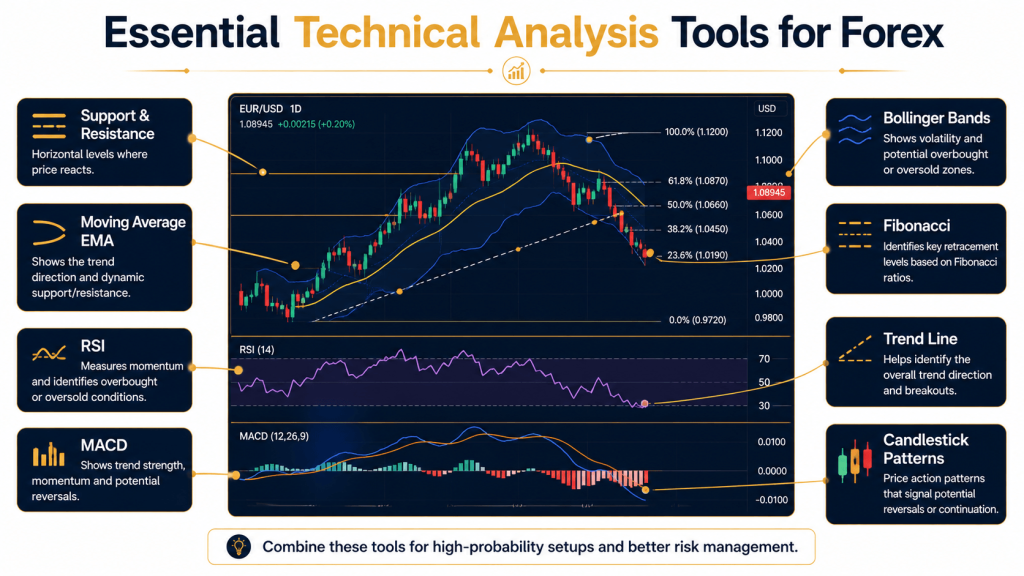
Technical analysis is the study of price charts and market data to forecast future price movements. It is the dominant analytical approach among Iranian retail traders — and for good reason: it requires no access to international financial news databases, works across all instruments and timeframes, and can be applied entirely within the trading platform.
Essential Technical Analysis Tools
| Tool | What It Does | Best Used For |
|---|---|---|
| Support & Resistance | Price levels where buying/selling pressure concentrates | Entry and exit points on all timeframes |
| Trend Lines | Visual representation of market direction | Identifying trend reversals |
| Moving Averages (MA, EMA) | Smooths price data to show trend direction | Trend confirmation, crossover signals |
| RSI (Relative Strength Index) | Measures overbought/oversold conditions (0–100) | Identifying potential reversals |
| MACD | Shows momentum and trend direction changes | Confirming entry signals |
| Bollinger Bands | Shows price volatility and potential breakouts | Volatility trading, range identification |
| Fibonacci Retracement | Identifies potential reversal levels after a trend move | Setting entry points after pullbacks |
| Candlestick Patterns | Price action signals from candle formations | Short-term reversal signals |
Smart Money Concepts (ICT) — The Growing Approach in Iran
Smart Money Concepts — developed by Michael Huddleston (ICT) and popularized in Iran by teachers like Mohammad Ali Poursamadi and Parisa Nasr — has become the dominant analytical framework among younger Iranian traders. It focuses on understanding how institutional money (banks, hedge funds) moves the market, rather than relying solely on retail indicators.
Key ICT concepts Iranian traders study:
- Order Blocks: zones where institutions placed large orders
- Fair Value Gaps (FVG): price imbalances that tend to get filled
- Liquidity sweeps: how smart money hunts retail stop-losses before reversing
- Market Structure: identifying breaks of structure (BOS) and changes of character (CHOCH)
Risk Management: The Skill That Separates Profitable from Losing Traders
Statistics consistently show that 70–80% of retail forex traders lose money. The primary reason is not a lack of trading knowledge — it is a lack of risk management discipline. Iranian traders who master this one area dramatically increase their chances of long-term survival in the market.
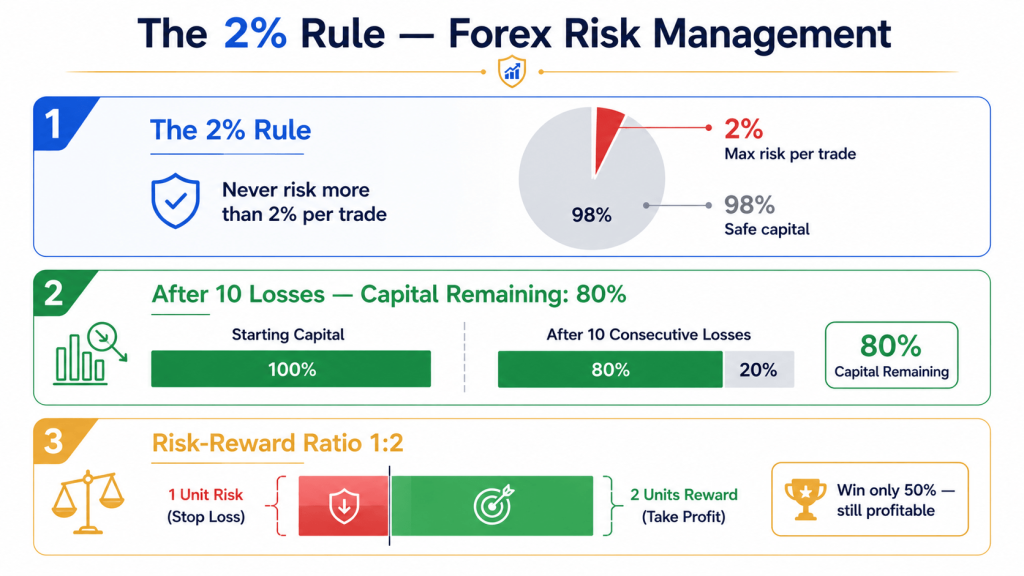
The 2% Rule
Never risk more than 2% of your total trading capital on a single trade. This ensures that even a losing streak of 10 consecutive losses — which happens to every trader — leaves you with 80% of your capital intact.
| Account Size | Max Risk Per Trade (2%) | After 10 Losses | Capital Remaining |
|---|---|---|---|
| $500 | $10 | $100 lost | $400 (80%) |
| $1,000 | $20 | $200 lost | $800 (80%) |
| $5,000 | $100 | $1,000 lost | $4,000 (80%) |
Stop-Loss: Non-Negotiable
Every trade must have a stop-loss order placed at the moment of entry. A stop-loss automatically closes your position if the market moves against you beyond a predefined level — protecting you from catastrophic loss.
- Place stop-loss beyond a structural level (support, resistance, order block)
- Never move a stop-loss further away from your entry to “give it more room”
- Calculate position size so that if stop-loss is hit, you lose no more than 2% of capital
Risk-to-Reward Ratio
Only take trades where the potential profit is at least twice the potential loss. A 1:2 risk-to-reward ratio means you can be wrong 50% of the time and still be profitable.
Islamic Forex Accounts for Iranian Muslim Traders
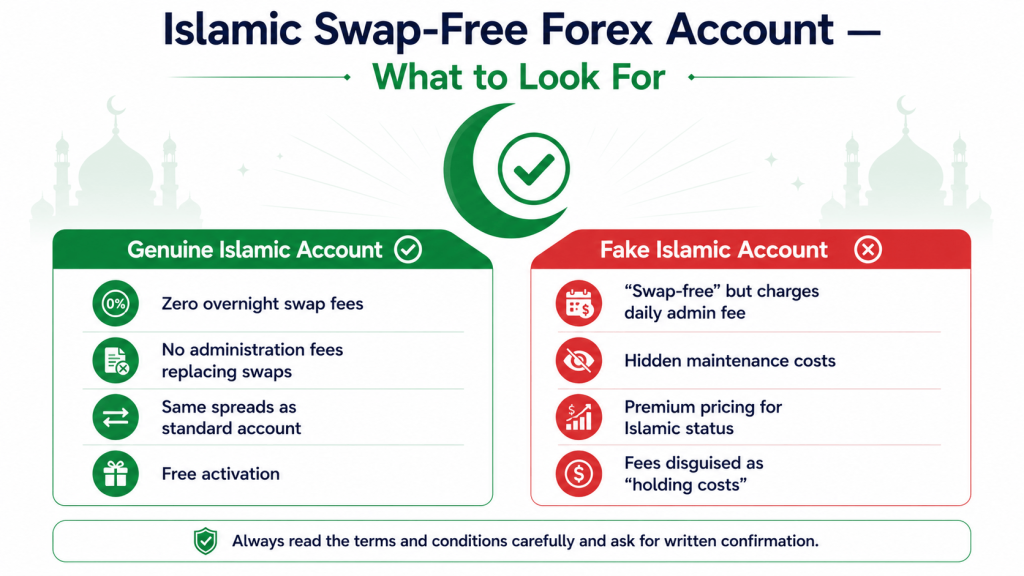
The majority of Iranian traders are Muslim, making the availability of a genuine Islamic (swap-free) forex account a critical factor in broker selection. A standard forex account charges or pays swap fees for positions held overnight — this is considered riba (interest) under Islamic law and is therefore prohibited for Muslim traders.
An Islamic forex account eliminates overnight swap fees entirely. However, Iranian traders must be careful: some brokers offer “Islamic accounts” that replace swaps with “administration fees” charged daily — which are functionally identical to swap fees under a different name.
What a genuine Islamic account looks like:
- ✅ Zero overnight swap fees on all instruments
- ✅ No “administration fees” or “holding fees” replacing swaps
- ✅ Same spreads and execution as standard accounts
- ✅ Available on ECN, Classic, and Standard account types
- ✅ Free activation — no premium charged for Islamic status
Investizo, accessible through forexirantrading.com, provides a genuine swap-free Islamic account at no extra charge across all instrument categories.
Choosing the Right Forex Broker for Iranian Traders
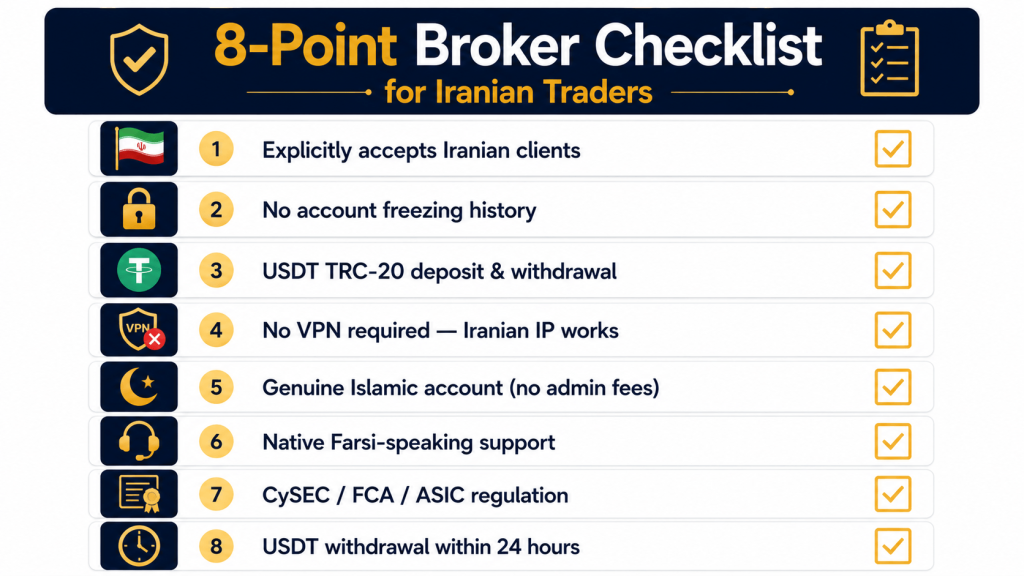
Not all international brokers are equal for Iranian traders. The checklist below reflects the specific requirements that Iranian traders face — requirements that most generic “best broker” lists completely ignore:
| Criterion | Why It Matters for Iranian Traders | What to Look For |
|---|---|---|
| Accepts Iranian clients | Many brokers list Iran as a restricted country | Explicit confirmation in Terms of Service |
| No account freezing | Some brokers accept registration but freeze at KYC stage | Community track record over 2+ years |
| USDT deposit & withdrawal | Only practical payment method for Iranians | TRC-20 and ERC-20 support confirmed |
| No VPN required | Platform should be accessible from Iranian IPs | Test registration page without VPN |
| Genuine Islamic account | No swap, no hidden administration fees | Confirm in writing — check for daily admin fees |
| Farsi-language support | Critical for resolving account issues quickly | Native Farsi speakers, not Google Translate |
| Regulation quality | Protects deposited funds from broker insolvency | Prefer CySEC, FCA, ASIC over offshore-only |
| Fast withdrawal processing | USDT withdrawals should clear within 24 hours | Test with a small withdrawal before large deposits |
Trading Psychology: The Hidden Factor in Iranian Forex Success
The technical knowledge to trade profitably is available for free — YouTube channels, articles, and books cover everything from candlestick patterns to ICT concepts in detail. Yet the majority of traders still lose money. The missing variable is trading psychology: the ability to execute your trading plan consistently under emotional pressure.
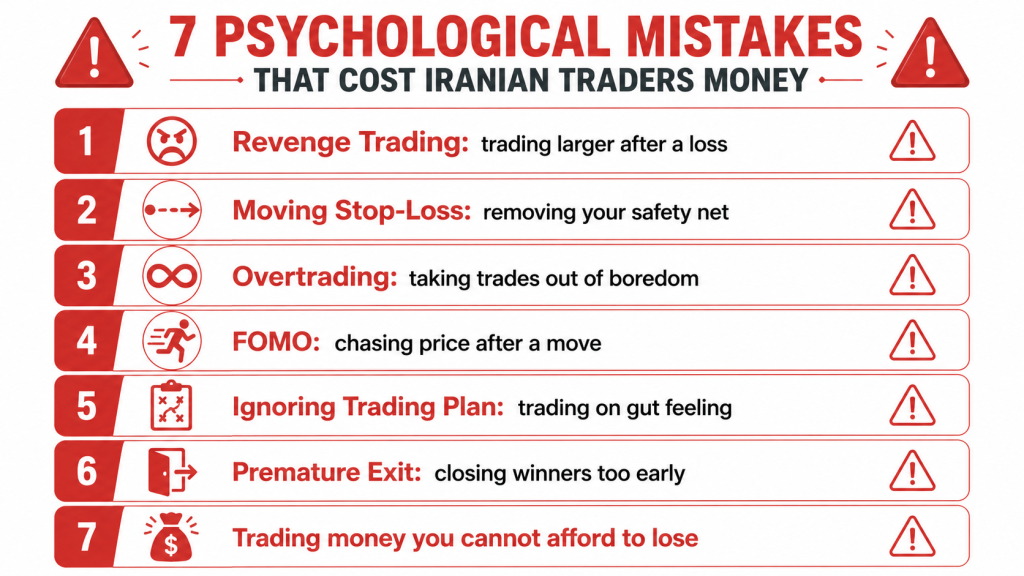
The 7 Psychological Mistakes That Cost Iranian Traders the Most
- 1. Revenge trading: After a loss, immediately opening a larger trade to “win it back.” This is the fastest way to blow an account. Rule: after two consecutive losses, stop trading for the day.
- 2. Moving the stop-loss: When price approaches your stop-loss, moving it further away to avoid the loss. This turns controlled losses into catastrophic ones.
- 3. Overtrading: Taking trades out of boredom or the need to “always be in the market.” Quality over quantity — professional traders sometimes wait days for the right setup.
- 4. FOMO (Fear of Missing Out): Entering a trade after a large move has already happened because you fear missing further profit. There is always another trade — missing one is never a reason to chase price.
- 5. Ignoring the trading plan: Entering trades based on intuition rather than your defined criteria. A trading plan exists precisely for high-pressure moments.
- 6. Premature profit-taking: Closing profitable trades too early out of fear that price will reverse. Let winners run — this is what creates a positive risk-to-reward ratio over time.
- 7. Depositing money you cannot afford to lose: Trading with rent money or borrowed funds creates emotional pressure that makes rational decision-making impossible.
Demo Account: Why Every Iranian Trader Must Start Here
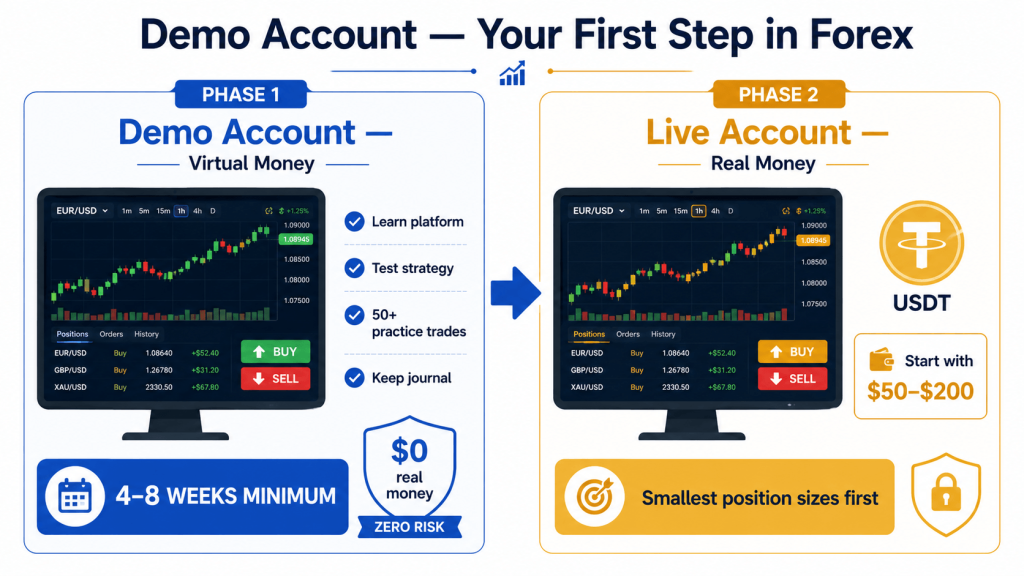
A demo account is a simulated trading environment that uses real market data and real-time price feeds — but with virtual money. It is the single most important step for any Iranian beginning their forex journey, and it is completely free.
What you should accomplish during your demo period:
- Learn to open, modify, and close trades on the platform
- Practice placing stop-loss and take-profit orders on every trade
- Test your trading strategy for at least 50–100 trades
- Keep a trading journal — record every trade, the reason for entry, and the outcome
- Achieve consistent results over at least 4–8 weeks before depositing real money
A critical point: demo trading feels different from live trading because there is no real money at risk. When you move to a live account, start with a small deposit ($50–$100) and trade the smallest possible position sizes. This bridges the psychological gap between demo and live conditions.
Frequently Asked Questions: Forex Trading in Iran
Is forex trading legal in Iran in 2026?
Personal forex trading through international brokers is not explicitly illegal in Iran. It operates in a legal grey area — there is no law criminalizing individual retail trading. No Iranian trader has faced legal prosecution for personal forex trading. The primary risk is financial: choosing an unreliable broker.
How do Iranian traders deposit money into forex accounts?
USDT (Tether) via the TRC-20 network is the standard deposit method. Iranian traders buy USDT from local exchanges (Nobitex) or P2P platforms, then transfer to their broker’s wallet address. Deposits typically confirm within 1 hour.
Which is the best instrument to trade for Iranians — gold, currency, or crypto?
Gold (XAU/USD) is the most popular among Iranian traders due to cultural familiarity and high liquidity. EUR/USD is recommended for beginners due to low spread and predictable behavior. Cryptocurrency CFDs offer high volatility but require more experience. Start with one instrument and master it before diversifying.
Do I need a VPN to trade forex in Iran?
For Investizo (forexirantrading.com), no VPN is required — Iranian IP addresses are not blocked. Many other brokers do block Iranian IPs. Always test the broker’s platform without VPN before depositing.
What is the minimum deposit to start forex trading in Iran?
With Investizo, the minimum deposit is $50. However, for meaningful risk management with the 2% rule, a starting capital of $200–$500 is more practical. Always start with demo account trading before any live deposit.
What is an Islamic forex account and how does it work?
An Islamic (swap-free) account eliminates overnight interest (swap) fees, making it compliant with Sharia law. A genuine Islamic account has no replacement fees. Investizo provides a free Islamic account with zero swap fees and no hidden administration charges.
How long does it take to become profitable in forex?
Realistic expectations: most traders spend 6–18 months in demo and small live account trading before achieving consistent profitability. Those who rush into large deposits without adequate preparation are in the group that loses money. Patience and systematic learning are the most reliable path.
What is the best time to trade forex from Iran (Tehran time)?
The London-New York overlap (16:30–20:30 Tehran time) is the highest liquidity period of the trading day — ideal for EUR/USD and XAU/USD. The London open (11:30 Tehran) is also excellent for GBP pairs and gold. Avoid trading during low-liquidity Asian session hours for major pairs.
Keep reading

Position Size Is the Only Variable You Fully Control
Traders obsess over entry signals and chart patterns—variables they can't control—while ignoring position size, the one decision that's entirely theirs and determines…

A Trading Plan That Fits on One Page Beats One That Does Not
Traders with written plans outperform by 30-40%, but most plans are too long to use under pressure. A one-page checklist beats a…